
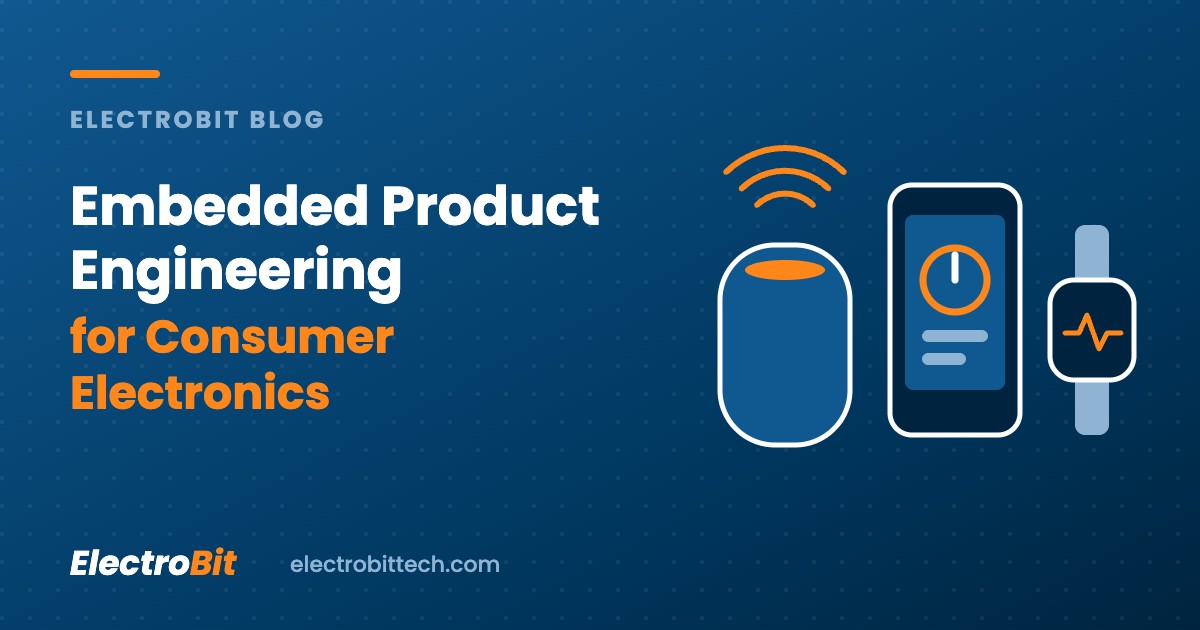
Consumer electronics is one of the toughest markets for hardware teams. Products must be small, affordable, battery-friendly, easy to use and certified, and they must reach shelves before competitors. Embedded product engineering is what makes these goals work together inside a single device.
This guide to embedded product engineering for consumer electronics covers the main engineering challenges, the US standards you need to plan for, and practical tips for a smoother launch.
What Embedded Product Engineering for Consumer Electronics Covers
From smart speakers and wearables to connected appliances and home automation devices, consumer products depend on:
- Compact, low-cost electronics and PCB design
- Low-power firmware that maximizes battery life
- Wireless connectivity such as Bluetooth Low Energy, Wi-Fi, Thread and Matter
- Companion mobile apps and cloud services
- Secure over-the-air (OTA) updates
- Design for high-volume manufacturing and test
Our embedded product engineering services cover each of these layers in one team.
Key Engineering Challenges
1. Size and Cost Pressure
Consumer products often sell at tight margins and high volumes, so every cent on the bill of materials matters. Engineers balance component cost, board layers and assembly steps against performance and reliability. Small savings per unit add up quickly at scale.
2. Battery Life
Users expect devices to last for days or months on a charge. Achieving that takes low-power processors and radios, deep sleep modes, event-driven firmware and careful measurement of real current draw on prototypes.
3. Wireless Performance in Small Enclosures
Tight plastic or metal enclosures, batteries and nearby components can weaken antenna performance. Antenna placement and tuning should be planned with the industrial design from the start. Our article on embedded product engineering vs product design explains how the two teams should work together.
4. Smart Home Interoperability
Buyers want devices that work with the platforms they already use. The Matter standard from the Connectivity Standards Alliance aims to let smart home devices from different brands work together, which makes it worth considering for new connected home products. Utility-connected appliances may also use standards such as CTA-2045 for demand response, as in our CTA-2045 protocol gateway project.
5. Security and Updates
Connected devices are targets for attackers. Secure boot, signed firmware, encrypted communication and a reliable OTA update path protect both users and your brand. In the US, the FCC is also rolling out the voluntary U.S. Cyber Trust Mark, a security label for consumer wireless IoT products.
6. Short Product Cycles
Consumer markets move fast. Reusable hardware platforms, modular firmware and automated testing help teams release new models and features without starting from scratch each time.
US Standards and Certifications to Plan For
- FCC Part 15: rules for devices that emit radio energy, covering both unintentional emitters (digital electronics) and intentional radiators (Wi-Fi, Bluetooth and other radios).
- UL / IEC 62368-1: safety standard for audio, video, information and communication technology equipment.
- Battery safety: IEC 62133-2 for portable lithium-ion cells and batteries, and UN 38.3 testing for shipping lithium batteries.
- U.S. Cyber Trust Mark: a voluntary FCC security label for consumer wireless IoT products.
Designing for these requirements from the first schematic, and running pre-compliance tests during prototyping, avoids late redesigns. See where certification fits in our guide to the embedded product engineering process.
Tips for a Successful Consumer Electronics Launch
- Lock requirements early: agree on battery life, size, features and target cost before layout starts.
- Prototype the risky parts first: test antenna performance, power draw and thermal behavior on early builds.
- Design for manufacturing and test: include test points, programming access and DFM reviews so the factory can build and test quickly.
- Plan for OTA from day one: leave memory and power headroom for future updates.
- Think about lifecycle: choose components with long availability and plan for obsolescence.
Conclusion
Consumer electronics success depends on getting many details right at once: cost, size, battery life, connectivity, security and certification. An experienced embedded product engineering team brings these together so your product reaches the market on time and keeps customers happy after launch.
Building a new smart device or refreshing an existing product line? Learn about our embedded product engineering services in the USA or book a free consultation.
Frequently Asked Questions
What certifications do consumer electronics need in the US?
Most need FCC authorization under Part 15 for radio emissions. Many also need safety testing to UL or IEC 62368-1, and products with lithium batteries usually need battery safety testing such as IEC 62133-2 and UN 38.3 for shipping.
How do you reduce power consumption in a consumer device?
Choose low-power processors and radios, use deep sleep modes, wake only on events, batch wireless transmissions and measure real current draw on prototypes throughout development.
What is Matter and do we need it?
Matter is a smart home connectivity standard from the Connectivity Standards Alliance that lets devices from different brands work together. It is worth considering for new smart home products that should work across major ecosystems.
Can you update a consumer device after it is sold?
Yes, if it is designed with secure over-the-air (OTA) updates. OTA lets you fix bugs, patch security issues and add features without a product recall.
Electrobit Engineering Team
Our hardware, firmware and software engineers design embedded products for OEMs across the United States, from concept to production.
On this page
Need an embedded product engineering partner?
From concept to production, with an NDA before discovery.
Related articles
Embedded Product Engineering for Consumer Electronics
Consumer devices must be small, low-cost, low-power and certified. Here is how embedded product engineering makes that possible.

Benefits of Embedded Product Engineering Services
Eight practical ways an experienced embedded engineering partner helps OEMs launch faster, spend less and support products for longer.
Embedded Product Engineering vs Product Design
Product design and embedded product engineering are often confused. Here is what each one covers and how they work together.
Embedded Product Engineering Process: 6 Key Stages
A clear, stage-by-stage look at how an embedded product moves from idea to mass production, and what to check before each step.